

Which Wood Material is Best?
MDF vs Plywood vs Particle Board vs HDHMR - Complete Guide 2025
Smart buying guide for Indian homeowners - Make informed decisions with expert insights
🎯 Key Findings: At a Glance
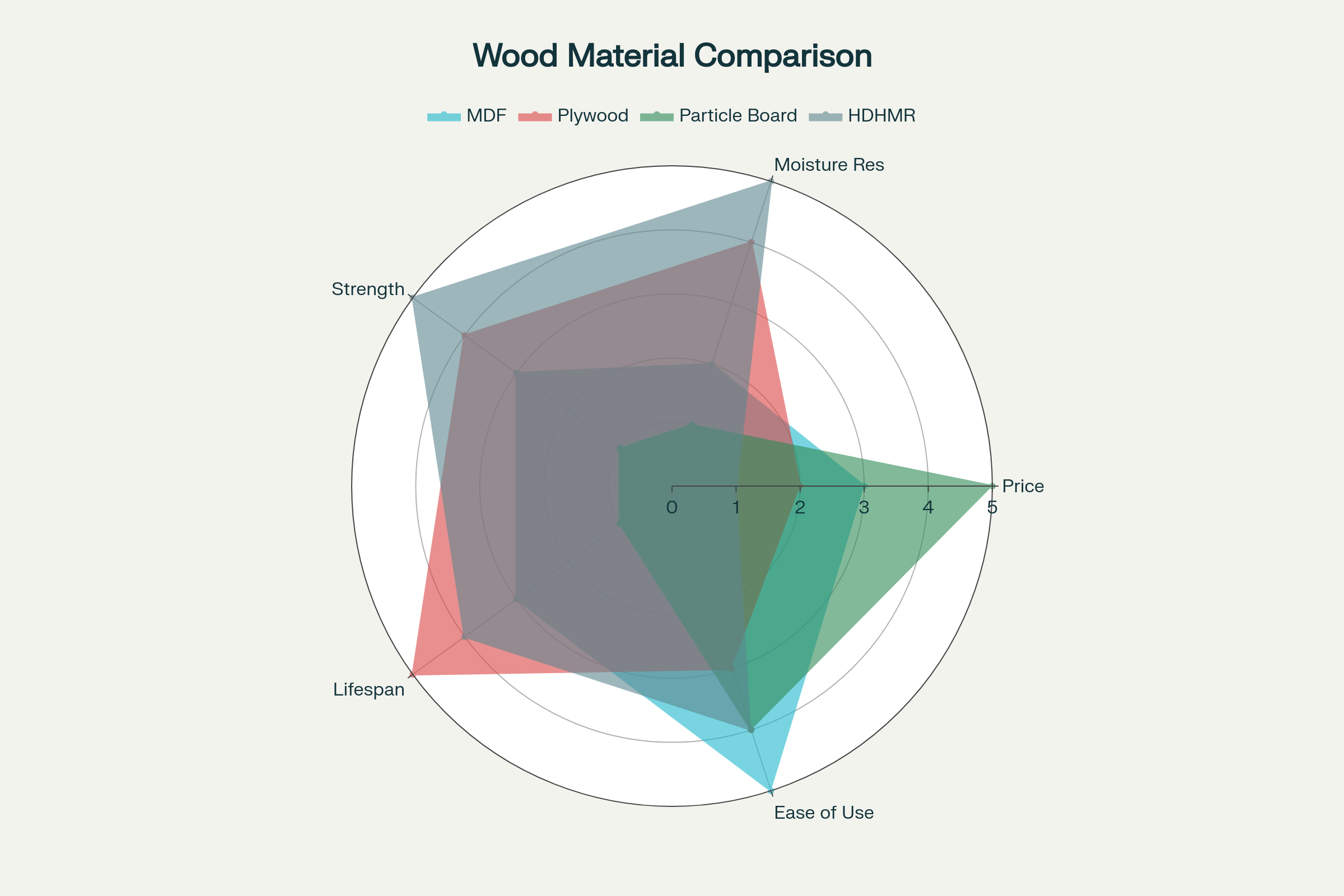
For most Indian homeowners, BWR Plywood offers the best balance of cost, durability, and performance, lasting 15-25 years with proper care. HDHMR is the premium choice for moisture-prone areas like kitchens and bathrooms, while MDF provides excellent value for painted furniture in dry areas. Particle Board should only be considered for temporary, budget-conscious applications.
🔍 Understanding Wood Materials: Key Definitions Made Simple
MDF is manufactured by breaking down wood into fine fibers, mixing them with resin glue, and pressing them under high heat and pressure. Think of it as "recycled wood powder" pressed into smooth sheets - perfect for painted furniture and decorative items.
Plywood consists of thin wood layers (veneers) glued together with alternating grain directions. This cross-grain construction provides exceptional strength - like a wooden sandwich that won't easily break.
Particle board uses wood chips, sawdust, and adhesive pressed together. It's the most economical option, using wood waste materials - perfect for budget-conscious homeowners who need basic furniture.
HDHMR combines wood fibers with special moisture-resistant additives, creating boards with exceptional density (850+ kg/m³). It's specifically engineered for India's humid climate and moisture-prone areas.
📊 Complete Material Comparison
| Feature | MDF | Plywood | Particle Board | HDHMR |
|---|---|---|---|---|
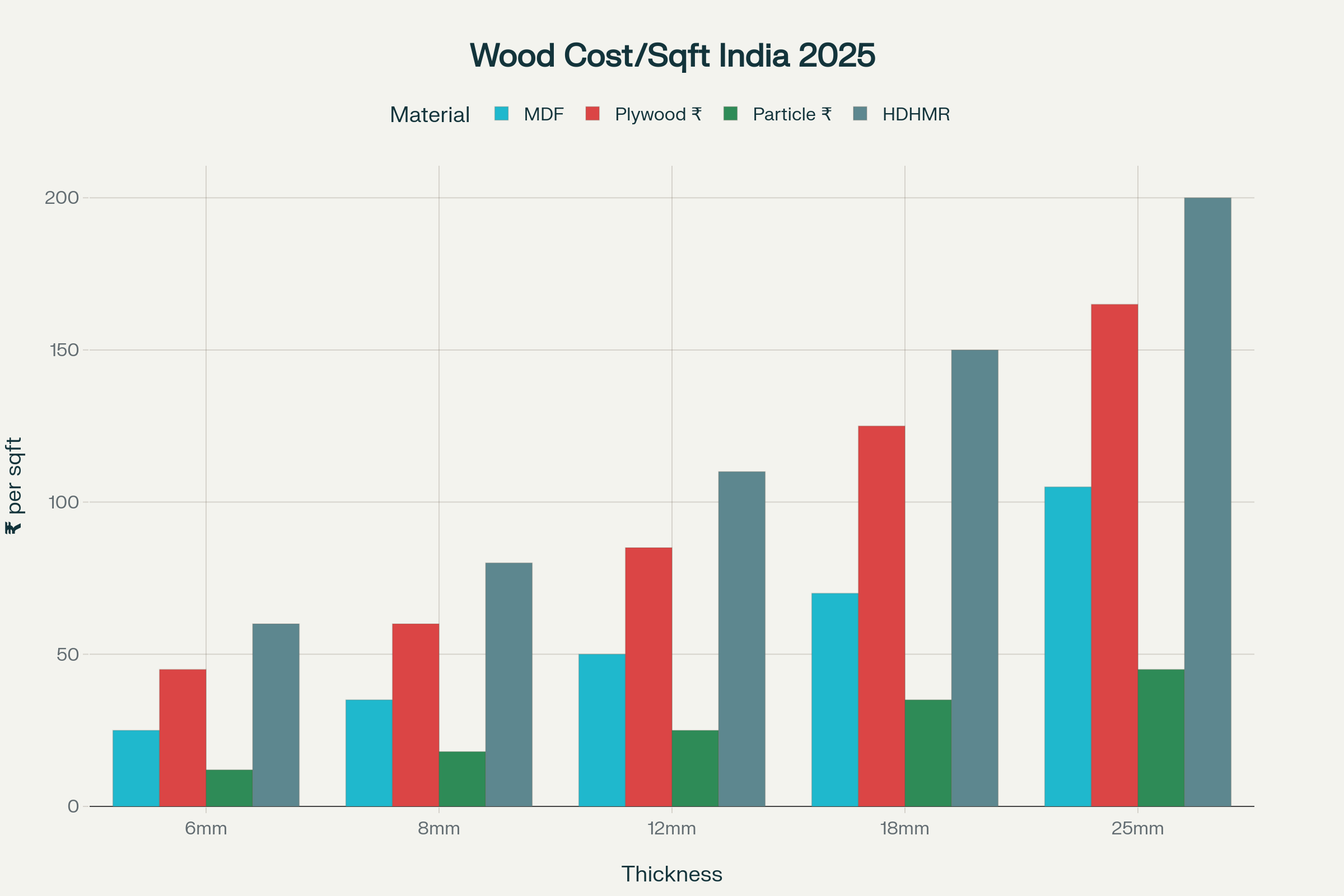
| Price Range (₹/sq ft) | ₹40-80 | ₹65-180 | ₹12-30 | ₹80-120 |
| Moisture Resistance | Low-Medium | High (BWR/BWP) | Very Low | Very High |
| Strength & Durability | Medium | High | Low | Very High |
| Lifespan | 8-10 years | 15-25 years | 2-5 years | 10-15 years |
| Weight | Heavy | Medium | Light | Very Heavy |
| Surface Finish | Very Smooth | Good (needs veneer) | Rough | Very Smooth |
| Best Applications | Painted furniture | Kitchen cabinets | Budget shelving | Bathroom/kitchen units |
🔬 In-Depth Analysis: Pros and Cons of Each Material
✅ Advantages
- Ultra-smooth finish: Perfect for painting and professional surfaces
- Cost-effective: More affordable than solid wood
- Easy to work with: Cuts cleanly without splintering
- Uniform density: No knots or grain patterns
❌ Disadvantages
- Poor moisture resistance: Swells when exposed to water
- Heavy weight: Requires strong hardware support
- Dust creation: Produces fine dust when cut
- Limited repair options: Difficult to fix once damaged
🎯 Best Applications
Painted wardrobes, decorative panels, interior doors, TV units, bookshelves in dry areas
✅ Advantages
- Exceptional strength: Cross-grain construction provides superior load-bearing
- Moisture resistant options: BWR and BWP grades handle humidity well
- Long lifespan: Can last 15-25 years with proper care
- Versatile: Suitable for both structural and decorative applications
❌ Disadvantages
- Higher cost: More expensive than MDF and particle board
- Variable quality: Cheap plywood may have voids and gaps
- Requires finishing: Needs veneer or laminate for appeal
- Edge sealing needed: Exposed edges must be sealed
🎯 Best Applications
Kitchen cabinets, structural furniture, outdoor furniture (marine grade), flooring, roofing
✅ Advantages
- Budget-friendly: Most affordable wood material option
- Lightweight: Easy to handle and transport
- Eco-friendly: Made from recycled wood waste
- Wide availability: Found in every hardware store
❌ Disadvantages
- Low strength: Cannot support heavy loads, tends to sag
- Poor moisture resistance: Disintegrates when wet
- Short lifespan: Typically lasts only 2-5 years
- Limited screw holding: Screws may pull out over time
🎯 Best Applications
Budget wardrobes, temporary shelving, backing panels, underlayment
✅ Advantages
- Superior moisture resistance: Ideal for India's humid climate
- High density and strength: Handles heavy loads without sagging
- Termite resistant: Pre-treated to resist pest damage
- Smooth finish: Ready for direct painting or lamination
❌ Disadvantages
- Highest cost: Most expensive among all four options
- Very heavy: Requires professional installation
- Limited availability: Not available in all local markets
- Newer technology: Less long-term performance data
🎯 Best Applications
Kitchen cabinets, bathroom vanities, areas with high humidity, premium furniture
🏠 Real-World Use Cases: Which Material for Which Application?
🍳 Kitchen Cabinets
Winner: HDHMR or BWP Plywood
Kitchen environments involve constant exposure to steam, heat, and moisture. HDHMR's superior moisture resistance makes it ideal, while BWP plywood offers proven long-term performance.
Avoid: MDF and particle board in kitchens
🚿 Bathroom Furniture
Winner: HDHMR
Bathrooms present the most challenging environment due to high humidity and water exposure. HDHMR's exceptional moisture resistance and termite protection make it the clear choice.
🛋️ Living Room Furniture
Winner: MDF (painted) or Plywood (with veneer)
For controlled indoor environments, MDF provides excellent value for modern painted furniture, while plywood with veneer offers traditional wood aesthetics.
👶 Children's Furniture
Winner: Plywood
High strength to handle rough use, safe (low formaldehyde emissions), and long-lasting investment for growing children.
💡 Expert Tips and Buying Guide
How to Choose the Right Material
💰 Consider Your Budget
- Tight budget: Particle board for temporary solutions
- Moderate budget: MDF for painted finishes
- Premium budget: BWP plywood or HDHMR
🌡️ Assess Your Environment
- High humidity: Choose HDHMR or BWP plywood
- Dry environments: MDF works well
- Water exposure: Avoid particle board completely
⚠️ Common Mistakes to Avoid
- Using MDF in bathrooms: Will swell and deteriorate quickly
- Choosing particle board for heavy storage: Will sag and potentially collapse
- Ignoring edge sealing: All materials need sealed edges for longevity
- Buying cheap plywood without checking quality: May have gaps and voids
- Not considering weight: Heavy materials need proper support systems
🏆 Final Verdict and Recommendations
🥇 For Most Indian Homes: BWR Plywood
Best balance of cost, durability, and performance. Proven track record in Indian conditions with wide availability and service support.
👑 For Premium Projects: HDHMR
Choose when moisture resistance is critical. Perfect for modern kitchens and bathrooms. Worth the extra cost for long-term durability.
💸 For Budget Builds: MDF
Excellent for painted furniture in dry areas. Professional finish at reasonable cost. Avoid in moisture-prone areas.
⏰ For Temporary Solutions: Particle Board
Use only when budget is extremely tight. Acceptable for low-load, temporary applications. Not recommended for primary furniture.
❓ Frequently Asked Questions
Which material is best for kitchen cabinets in India's humid climate?
HDHMR is the best choice for kitchen cabinets due to its superior moisture resistance and ability to handle steam from cooking. BWP plywood is the second-best option with proven long-term performance.
Is MDF safe for children's furniture?
Yes, high-quality MDF with E1 or E0 emission standards is safe for children's furniture. However, plywood might be a better choice for kids' rooms due to higher strength and lower formaldehyde content.
How long does each material typically last?
- Particle Board: 2-5 years
- MDF: 8-10 years
- Plywood: 15-25 years
- HDHMR: 10-15 years
Which material offers the best value for money?
For most applications, BWR plywood offers the best value for money considering its durability, strength, and longevity. While initially more expensive, its 15-25 year lifespan makes it cost-effective.
Is HDHMR worth the extra cost?
HDHMR is worth the extra cost in moisture-prone areas like kitchens, bathrooms, and coastal regions. For dry areas, good-quality plywood or MDF might be more economical.
🚀 Ready to Make Your Smart Choice?
Now that you have all the information, it's time to make your decision! Remember to assess your specific needs, choose quality over cheapest price, and get professional installation for best results.
Share This Guide Get Expert ConsultationUpdated for 2025 Indian market conditions. Prices may vary by location and supplier. Always verify current rates and availability in your area.